
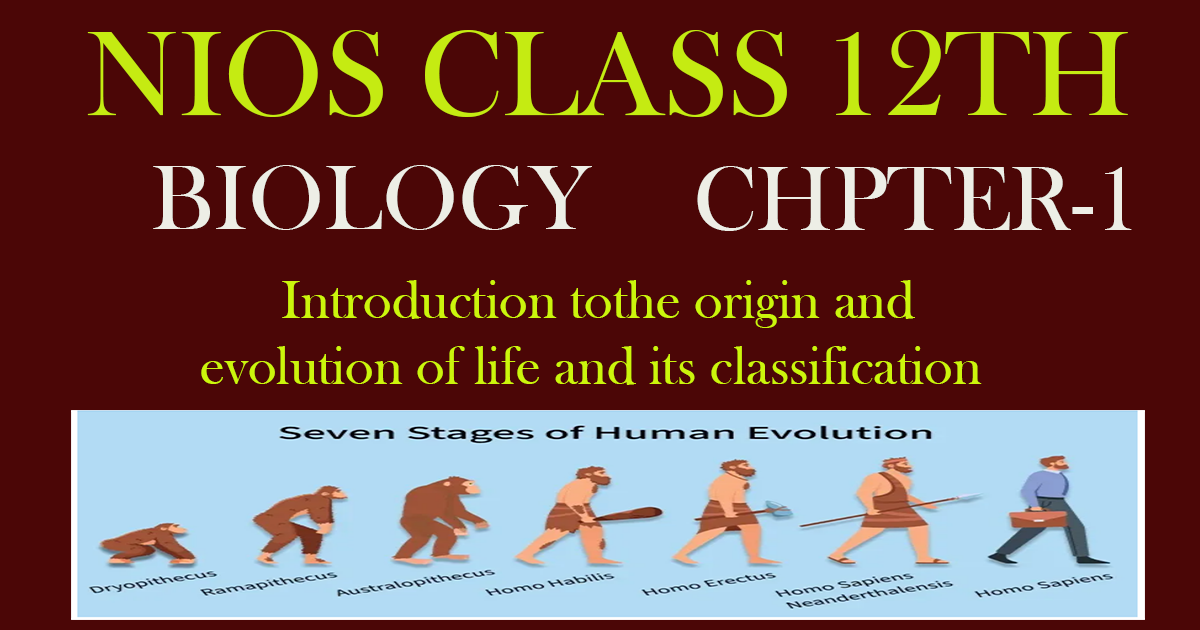
NIOS CLASS 12TH BIOLOGY CHAPTER 1ST
Introduction to the Origin, Evolution, and Classification of Life
Q-1 What is Reproduction? Explain in detail.
Answer- It is a biological process in which an organism produces offspring similar to itself. This process is essential for the continuation of the species.
Types of Reproduction
Reproduction is mainly of three types:
① Asexual Reproduction
② Sexual Reproduction
③ Vegetative Reproduction
1. Asexual Reproduction:- Asexual reproduction occurs in unicellular organisms as well as in some plants.
Its main points are:
1. It mainly involves only one parent.
2. The offspring produced are identical to the parent.
Types of Asexual Reproduction
Asexual reproduction is mainly of 5 types:
(1) Fission
(a) Binary Fission (b) Multiple Fission
(2) Budding
(3) Fragmentation
(4) Spore formation
(5) Vegetative propagation
② Sexual Reproduction
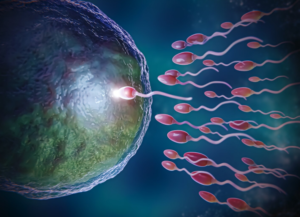
This type of reproduction is found in highly developed organisms. It is a process that takes place between male and female. It involves the formation of gametes and fertilization.
Sexual reproduction occurs in the following stages:
- Gamete formation (Gametogenesis)
- Fertilization
- Formation of Zygote
- Embryo development
- Birth
- Vegetative Reproduction –
New plants are produced from roots, stems, and leaves; this is called vegetative reproduction or vegetative propagation.
Types of Vegetative Reproduction
- Natural Vegetative Reproduction
- Artificial Vegetative Reproduction
- Natural Vegetative Reproduction:
In this, the modified part of the plant or vegetative propagule naturally germinates and gives rise to a new plant. This is accomplished in the following ways: Vegetative reproduction through roots:When a plant gives rise to an identical plant through its roots,
this is called vegetative reproduction through roots.
Example – Sweet potato
2. Vegetative reproduction through stems:-In this, reproduction occurs naturally through the stems.
Examples – Ginger, potato, turmeric
3. Vegetative reproduction through leaves: In this, an identical plant is born from the leaf.
Example – Bryophyllum
Q. 2 What is lifespan? Explain in detail.
Answer – Lifespan: The time period from the birth to the death of a human or organism, provided the death is natural. This is called lifespan. The lifespan of a human is considered to be 70 to 75 years.
The lifespan of some organisms is as follows. (1) Human life span: 70 to 75 years
- Dog’s life span: 20 to 25 years
- Cow’s life span: 20 to 25 years
- Horse’s life span: 50 to 55 years
- Elephant’s life span: 65 to 70 years
Q.3 – Explain asexual reproduction in detail.
Answer – In asexual reproduction, the offspring produced are exactly like their parent. Asexual reproduction is also called single-organism reproduction.
Methods of asexual reproduction:
There are 6 methods of asexual reproduction.
- Binary fission
- Sporulation
- Budding
- Gemmules
- Fragmentation
- Regeneration
① Binary fission:- It is also called binary division. In this method, during reproduction, the parent’s body divides into two parts through mitotic division, resulting in two offspring.
②Sporulation:- In this method, during reproduction, a unicellular structure with a thin covering (wall) is formed in the cell or outer part of the organism. This is called a spore. After some time, this spore separates from the plant and spreads to different places, forming new organisms. This process is called sporulation.
Examples – Chlamydomonas, algae, etc.
(3) Budding: Budding is found in yeast. In this method, a very small bud is formed on the outer part of the yeast cell during reproduction. This is called budding. This bud separates from the yeast and after some time forms a new yeast.
④ Gemmules: This is mainly found on the tip of a plant, leaf, or stem. The anterior (front) part forms multicellular, green, spherical structures. These structures develop into new plants after a suitable period.
(5) Fragmentation: In this process, the body of a multicellular parent organism spontaneously breaks into two or more fragments, and each fragment develops into a new organism after some time.
Example: Spirogyra algae
(6) Regeneration: When an organism is divided into two or more parts, but each part contains a portion of the nucleus, it can regenerate and form a complete body through cell division.
Examples:
Hydra, Amoeba, Planaria

Nice