NIOS Class 12 Chemistry Chapter 2 Atomic Structure
Question: Define an atom.
Answer:- An atom is the smallest electrically neutral unit of an element that retains the chemical properties of that element.
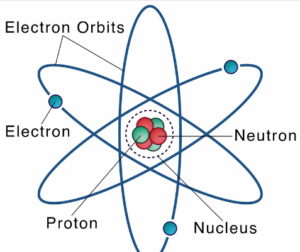
An atom is primarily composed of three subatomic particles:
Proton — Positively charged (+)
Neutron — Neutral (0)
Electron — Negatively charged (−)
From a modern perspective, the atom is not considered indivisible, as protons and neutrons are themselves composed of even smaller particles, such as quarks.
Question: What are the main components of the basic structure of an atom?
Answer:- The basic structure of an atom consists primarily of two parts:
The nucleus, and
The electron cloud region.
Nucleus: The nucleus is located at the center of the atom. It contains protons and neutrons. Almost the entire mass of the atom is concentrated in the nucleus. The charge of the nucleus is always positive.
Electron Cloud Region: Electrons are found in various energy levels or orbitals surrounding the nucleus. Electrons play a crucial role in the chemical behavior of an atom. Specifically, valence electrons play a key role in forming chemical bonds.
Subatomic Particles:
Particle | Charge | Relative Mass | Location
Proton | +1 | Approx. 1 u | Nucleus
Neutron | 0 | Approx. 1 u | Nucleus
Electron | −1 | Approx. 1/1836 u | Outside the nucleus
Important Fact: Number of protons = Atomic number (Z)
Example: Oxygen has 8 protons. Therefore, the atomic number of O = 8.
Question: Define Atomic Number ?
Ans:- The number of protons present in the nucleus of an atom of an element is called its atomic number. It is denoted by Z. Z = Number of protons. For a neutral atom, the number of protons = the number of electrons.
Example: Atomic number of Sodium (Na) = 11
Therefore,
Protons = 11,
Electrons = 11.
NIOS Class 12 Chemistry Chapter 2 Atomic Structure
Question What is Mass Number?
Ans:- The total number of protons and neutrons present in the nucleus of an atom is called the mass number. It is denoted by A.
A = Protons + Neutrons
Therefore, Neutrons = A − Z
Example: Sodium-23: • Z = 11 • A = 23
Question – Evolution of the Atom — Contributions of Scientists
Ans:- 1. Democritus The ancient Greek philosopher Democritus conceptualized the smallest indivisible particle of matter and named it *Atomos*.
Atomos = That which cannot be divided.
2. John Dalton — 1803 Dalton proposed the modern atomic theory.
Key points:
• Matter is composed of atoms.
• Atoms of the same element are considered identical.
• Atoms of different elements are different.
• Atoms rearrange during chemical reactions.
• Atoms combine in simple whole-number ratios to form compounds.
Limitations of Dalton’s theory
Modern science has shown that:
• The atom is not indivisible.
• Atoms of the same element can have different masses — Isotopes.
• Atoms can undergo changes in nuclear reactions.
Question – Who is J.J. Thomson
Ans:- Discovery of the Electron: J.J. Thomson discovered the electron in 1897. Through the cathode ray experiment, he demonstrated the presence of negatively charged particles within the atom.
Thomson’s atomic model: This was known as the Plum Pudding Model. In this model:
• The atom was considered a sphere of positive charge.
• Electrons were considered to be embedded within it.
Later, this model proved to be unsuccessful.
Question – Define Rutherford’s atomic model
Ans:- Ernest Rutherford conducted the famous gold foil experiment.
He bombarded a thin gold foil with alpha particles.
Key observations:
• Most alpha particles passed straight through.
• Some were slightly deflected.
• Very few particles bounced back.
From this, Rutherford concluded:
1. Most of the atom is empty space.
2. The positive charge and almost the entire mass are concentrated in a small region.
3. This small region was named the nucleus. 4. Electrons revolve around the nucleus.
Problem with Rutherford’s model:
According to classical physics, a revolving electron should lose energy and eventually fall into the nucleus.
Therefore, this model could not fully explain the stability of the atom.
Question – Niels Bohr’s atomic model: Niels Bohr proposed the Bohr model in 1913.
Ans:- According to it:
• Electrons reside in fixed energy levels or orbits.
• Electrons do not emit energy while in these orbits.
• Electrons absorb or emit energy when moving from one energy level to another.
Energy change:
ΔE = hν
Where:
• ΔE = Energy difference
• h = Planck’s constant
• ν = Frequency of radiation
Absorption of energy:
The electron moves from a lower energy level to a higher energy level.
Emission of energy: The electron moves from a higher energy level to a lower energy level.
Question – What is Modern atomic model?
Ans:- According to modern quantum mechanics, electrons do not revolve in fixed circular orbits. The position of an electron is described in terms of probability. The region where there is a high probability of finding an electron is called an orbital.
Major orbitals:
• s
• p
• d
• f
Their maximum electron capacity:
• s = 2
• p = 6
• d = 10
• f = 14
Neutrons: 23 − 11 = 12; that is, protons = 11, neutrons = 12, electrons = 11.
12. Isotopes –
Ans:- Atoms of the same element that have the same atomic number but different mass numbers are called isotopes. That is: same number of protons, different number of neutrons. Examples: Isotopes of hydrogen:
• Protium — ¹H
• Deuterium — ²H
• Tritium — ³H
In all three, the number of protons is 1, but the number of neutrons differs.
Uses
•
• Medicine
• Radiotherapy
• Nuclear energy
• Scientific research
• Carbon dating
13. Isobars –
Ans:- Atoms that have the same mass number but different atomic numbers are called isobars.
Examples:
⁴⁰Ar and ⁴⁰Ca
Both have a mass number of 40, but their atomic numbers differ.
14. Isotones –
Ans:- Atoms that have the same number of neutrons are called isotones.
Examples: ¹⁴C: Protons = 6, Neutrons = 8; ¹⁵N: Protons = 7, Neutrons = 8
Therefore, both are isotones.
15. Ion –
Ans:- When an atom gains or loses electrons, it becomes an ion.
Cation – A positive ion is formed upon losing electrons.
Example: Na → Na⁺ + e⁻
Anion – A negative ion is formed upon gaining electrons.
Example:
Cl + e⁻ → Cl⁻
16. Difference between atom and molecule
Ans:- Atom: The smallest unit of an element that retains its chemical properties.
Molecule: An independent particle formed by the chemical bonding of two or more atoms.
Examples: O₂ = Oxygen molecule
H₂O = Water molecule
17. Why is an atom electrically neutral?
Ans:- In a normal atom: Number of protons = Number of electrons
Therefore, the positive and negative charges balance each other out. 18. Most important formulas
Atomic number (Z) = Number of protons
Electrons in a neutral atom = Protons
Mass number (A) = Protons + Neutrons
Neutrons = A − Z
An element is identified by its number of protons.
Read – Important Chapters>
Nios Class 12th physics Chapter 1st
भारतीय संविधान में मौलिक कर्तव्य (अनुच्छेद 51A)